

Key Insights:
- Jupiter’s new global payments and ecosystem explorer products have yet to drive significant price movement.
- Despite positive developments, Jupiter token faces downward pressure, with recent price action showing lower highs.
- Market outflows signal continued distribution, indicating weak investor sentiment despite product improvements.
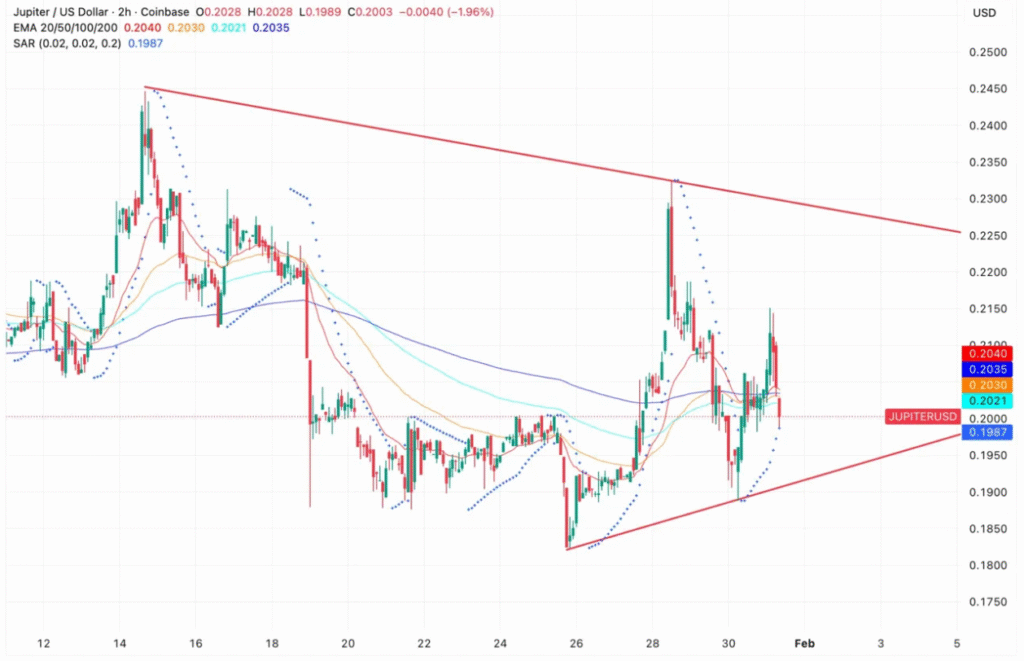
Jupiter’s price is currently hovering around $0.20 after retreating from the $0.22 resistance zone reached earlier this week. This dip follows the launch of two major products by the protocol that were expected to provide fundamental support, but the broader market weakness has continued to impact the performance of Solana ecosystem tokens. Despite these developments, Jupiter has not managed to decouple from the broader market trend.
Jupiter introduced two notable products this week, signaling its expansion beyond its core decentralized exchange (DEX) aggregator function. Jupiter Global introduces a new way to make real-world payments through a QR code functionality, allowing users to complete transactions across Asia-Pacific merchants without any fees. Additionally, it offers global fiat remittance services with support for virtual USD, GBP, and EUR accounts, and SWIFT transfers to over 200 countries. A Jupiter Card is also available for USDC spending at over 150 million merchants worldwide.
Meanwhile, the Solana Ecosystem Explorer, launched on January 31, integrates data from Solscan and DefiLlama into a unified interface. This allows users to access detailed project financials, including fees, revenue, and total value locked (TVL), as well as social metrics and user activity, all in one place. While these product launches expand Jupiter’s utility, they have not had the desired effect on its price.
Spot Outflows Signal Continued Market Distribution
Data from Coinglass indicates that Jupiter saw $1.65 million in net outflows during the week ending January 26, 2023. This pattern of selling pressure has been persistent, with only occasional small inflows that fail to reverse the broader trend. Despite the positive product updates, it seems that market sentiment remains focused on broader risk factors, as evidenced by the ongoing outflows from Solana ecosystem tokens.
Jupiter’s price action also reflects this bearish sentiment, with a consistent downtrend since mid-January. The $0.22 resistance zone and the descending trendline from the January highs have capped rallies, and the $0.1850 range has become a key support level that bulls must defend.
Technical Indicators Point to Continued Bearish Momentum
On the 2-hour chart, all four major exponential moving averages (EMAs) have converged near the $0.20 price level, creating a decision point. The 20-day, 50-day, 100-day, and 200-day EMAs are tightly clustered between $0.2021 and $0.2040, indicating indecision in the market. The Parabolic SAR has flipped bearish, confirming short-term downside momentum.
If Jupiter fails to hold the $0.1987 support level, it may see further declines toward the $0.1850 range. Conversely, a move above $0.21 with strong volume could signal renewed bullish interest and a potential retest of the $0.225 resistance level.
Jupiter’s recent product launches have certainly expanded its utility, but the ongoing market weakness continues to overshadow these developments. For now, price action suggests that bears remain in control, with key technical levels defining the next potential moves. The market’s broader sentiment will likely play a significant role in Jupiter’s next price direction.