
- FET gained 33.8% in Q3, rising from $0.171 to $0.229 after recovering from August’s $0.121 low.
- Athena expanded beyond PRO users, giving every account three free projects for testing multi-step agent tasks.
- A compromised converter signing key reportedly drained 8.72 million FET, prompting Fetch.ai to suspend AGIX conversions.
Fetch.ai Q3 recap shows FET rising 33.8% as the project expanded its agent products, added integrations and dealt with a security breach involving its token converter.
FET Rebounds as Fetch.ai Expands Its Products
In its Q3 2026 recap, Whale Factor reported that FET gained 33.8% between July and September. The account traced the rise from $0.171 on July 1 to $0.229 on September 30. It also reported an August low of $0.121 and a late-September peak of $0.247.
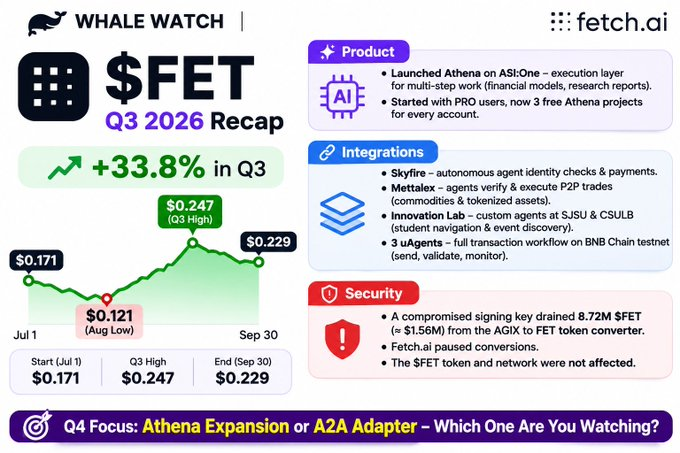
The quarterly advance placed FET well above its July starting level. However, the September close remained below the $0.247 peak. That pullback leaves the next move open rather than settled. Buyers will need to defend the recovery during Q4.
Fetch.ai launched Athena on ASI during the quarter. The product handles multi-step work, including financial models and research reports. It first became available to PRO users. Access later expanded, with three free projects for every account.
The wider release gives users an opportunity to test Athena directly. Its appeal will depend on the quality of completed work. Financial research and financial modelling hardly leave any room for unreliable results. Frequent use would be better evidence than the first trials.
Agent Integrations Extend Beyond Fetch.ai
Fetch.ai also released an A2A Outbound Adapter for Google’s Agent2Agent protocol. It connects the uAgents framework with compatible external agent systems. Agents can find one another, exchange messages and make payments. This allows activity to extend beyond Fetch.ai’s own framework.
Skyfire added identity checks and payment functions for autonomous agents. These tools support transactions without requiring direct human intervention. Mettalex has also deployed agents for peer-to-peer commodity trades. Its activity covers tokenized assets alongside commodities.

Fetch.ai’s Innovation Lab introduced custom agents at two universities. Deployments were made to San José State University and California State University – Long Beach. Their reported uses include student navigation and event discovery. The recap does not provide figures for student adoption or usage.
A BNB Chain testnet exercise involved three separate uAgents. One handled transaction submission, another validation, and the third monitoring. The demonstration showed agents dividing work across a transaction process. It did not establish production-scale activity or commercial demand.
Converter Breach Interrupts AGIX Transfers
The quarter also brought a security incident involving the AGIX-to-FET converter. A compromised signing key reportedly enabled the withdrawal of 8.72 million FET. Whale Factor valued the amount at approximately $1.56 million. Fetch.ai paused conversions after discovering the incident.
The recap states that FET and its network were unaffected. The signing key of the converter was compromised. That’s where the incident differs from a network breach. The defeat has, however, left the question of converter security unanswered.
The pause stopped conversions while the incident was addressed. Users relying on that route faced an interruption. The supplied recap gives no further details about restoration. It also does not identify the compromised key’s recovery status.
Q4 now brings two developments into sharper view. Athena needs to attract repeat users beyond its initial free projects. The A2A adapter needs working connections that generate actual agent activity. Both require evidence through usage, not announcements alone.
For FET holders, the Q3 rally offers a strong quarterly result. Yet the token closed below its late-September high. The next quarter will test whether product adoption can support demand. Security safeguards will also remain part of the project’s record.