
Key Insights
- Shiba Inu recorded a 24 billion token outflow from exchanges, reducing immediate selling supply and signaling a shift in short-term market positioning.
- Price action shows a mild recovery as SHIB forms a short-term ascending pattern, indicating early stabilization despite remaining below key resistance levels.
- Exchange reserve decline suggests accumulation behavior among investors, reflecting reduced intent to sell and a possible slowdown in prolonged bearish momentum.
Shiba Inu recorded a sharp decline in exchange reserves after roughly 24 billion SHIB tokens moved off trading platforms within 24 hours. This shift reduced the pool of tokens readily available for quick liquidation. Consequently, the immediate selling pressure that has weighed on the asset for months showed signs of easing as traders adjusted their positions.
Exchange flow metrics often reflect investor intent, and recent outflows suggest a move away from short-term selling activity. Besides, investors typically transfer assets to private wallets when they expect to hold rather than sell. This pattern indicates that some market participants may now favor accumulation over distribution.
Prolonged Downtrend Still Defines Broader Structure
Despite this development, Shiba Inu remains within a broader downtrend marked by consistent lower highs and lower lows. Moreover, key technical indicators continue to reflect weakness, with the price trading below major moving averages. These levels, including the 50-day and 100-day exponential moving averages, still act as dynamic resistance zones.
Recent trading sessions show a modest recovery from local lows, with SHIB forming a short-term ascending structure. However, this upward movement remains limited and lacks strong confirmation. Buyers have started to step in, although the price still trades near nearby resistance levels.
Reduced Exchange Supply Alters Short-Term Dynamics
The decline in exchange-held tokens has altered short-term supply conditions, which may influence price stability. Additionally, lower available supply on exchanges can reduce the pace of rapid sell-offs. This shift does not confirm a reversal, yet it highlights a notable change in market dynamics.
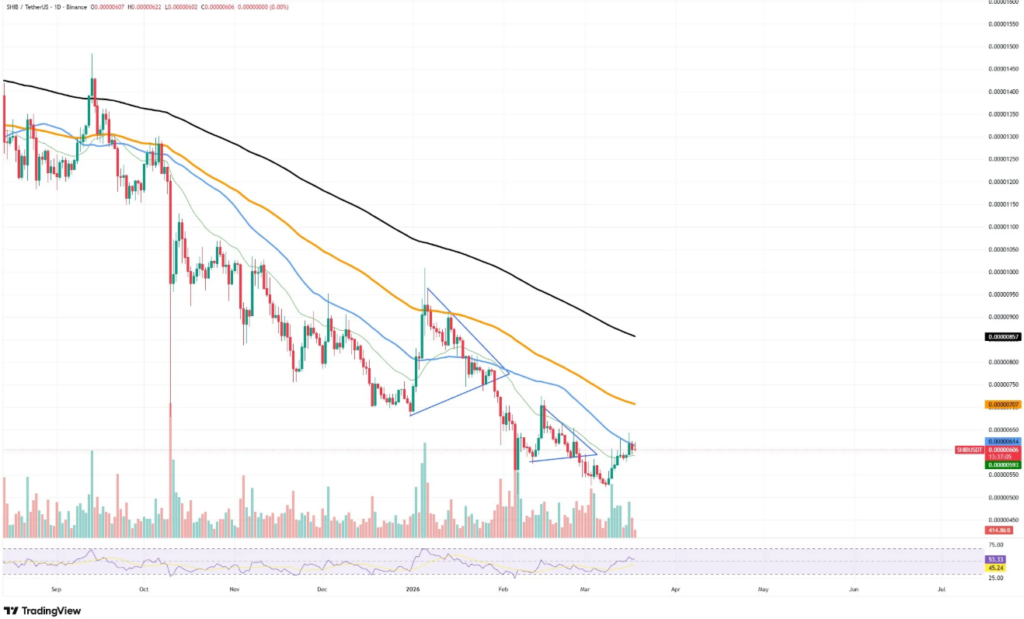
Shiba Inu still faces strong resistance from downward-sloping moving averages, which continue to limit upward momentum. Hence, the asset must reclaim these levels to confirm any sustained recovery. Until then, the broader trend remains under pressure despite short-term improvements.
Market Signals Indicate Slowing Bearish Momentum
The combination of exchange outflows and slight price recovery suggests that bearish momentum may be losing strength. Moreover, reduced selling activity could support gradual stabilization if demand continues to build. However, stronger technical confirmation remains necessary before a broader trend shift takes hold.