
- Nearly 67% of TAO remains staked, showing continued network participation despite recent market weakness and volatility.
- Alpha staking growth reflects increasing capital movement toward subnet-specific AI economies across the Bittensor network.
- TAO traded near $250 while investors weighed staking yields against tokenized treasury-based alternatives.
TAO Yield Dynamics remained a key market focus as Bittensor activity evolved. Investors tracked staking allocation trends and price performance while assessing network-based returns against traditional yield-generating digital assets.
Staking Activity Signals Changing Capital Preferences
A recent Taostats dashboard presentation focused on realized network yields. The platform tracks validator distributions using on-chain data. Reported figures reflect actual payouts rather than projected returns.
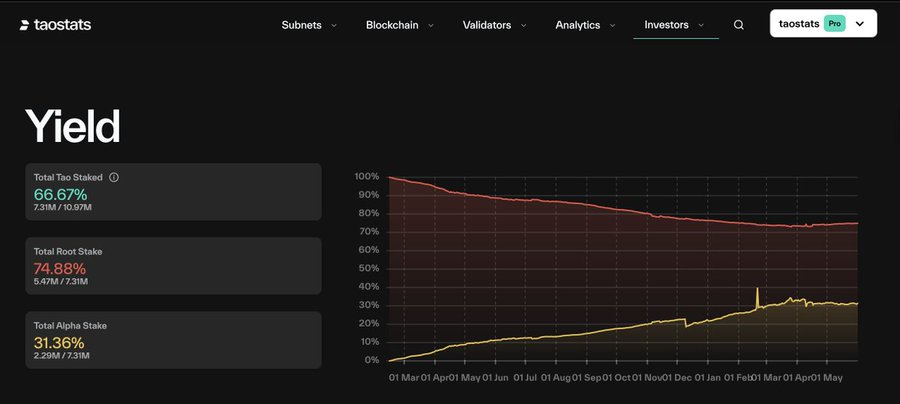
Network statistics showed approximately 66.7% of all TAO currently staked. That level indicates broad participation across the ecosystem. Many holders continue earning emissions instead of remaining inactive.
Data also revealed a shift between staking categories over time. Root staking’s share declined steadily during the observed period. Meanwhile, Alpha staking expanded across multiple months.
The transition appeared gradual rather than driven by sudden speculation. Market participants increasingly allocated capital toward specific subnets. That movement reflected growing interest in subnet-level opportunities.
Alpha Staking Expansion Draws Investor Attention
According to information shared on social media, Alpha staking differs significantly. Users convert TAO into subnet-specific Alpha assets. Those assets can then be staked within individual subnets.
Several subnet categories were referenced within the discussion. Examples included weather forecasting and GPU compute networks. Real-time translation and drug discovery applications were also mentioned.
Each subnet operates with its own emission-based economy structure. Rewards depend on activity and performance within that environment. Returns therefore vary considerably across different subnet ecosystems.

The chart showed Alpha participation rising toward roughly 30%. At the same time, Root staking trended lower. The pattern suggested increasing interest in targeted exposure rather than broad diversification.
Price Action Reflects Broader Market Conditions
Bittensor at the time of writing, traded at approximately $250.36 during the reported session. The asset recorded a decline of about 3.06% over 24 hours. Market capitalization stood near $2.74 billion.
Comparative performance data placed TAO alongside ONDO. Both assets moved lower during the session. However, ONDO experienced wider intraday fluctuations.
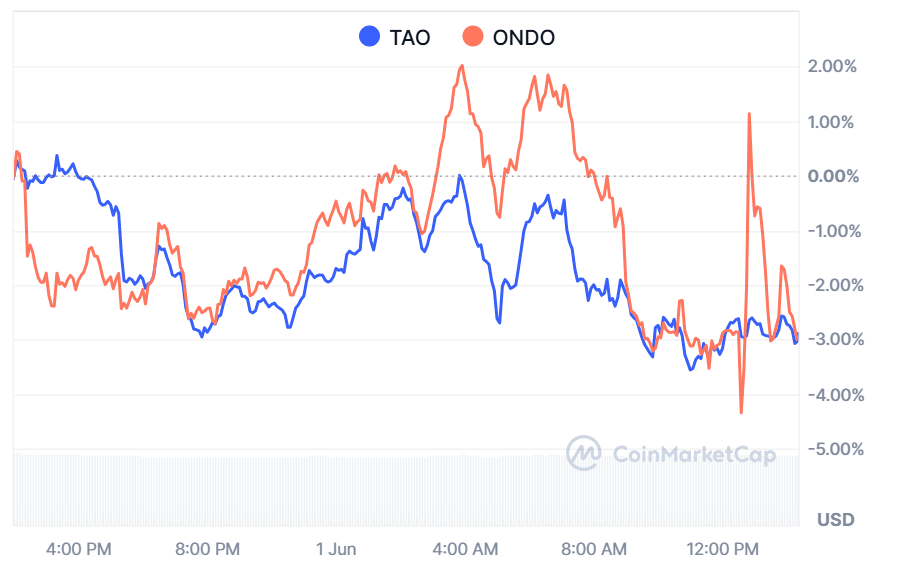
TAO attempted several recoveries throughout the trading period. Buyers pushed prices closer to flat performance temporarily. Those gains later faded as selling pressure returned.
The discussion also compared staking returns with tokenized yield products. OUSG and USDY were cited as examples. While treasury-backed products generate fixed-income exposure, Bittensor staking remains linked to activity within decentralized AI economies.
Market participants continue evaluating those differing return structures. Some focus on stability and government debt exposure. Others monitor network productivity and subnet-level reward generation.
As trading continues, investors remain focused on staking participation. Capital allocation trends remain a closely watched metric. Price action and yield opportunities continue shaping Bittensor’s market narrative.